
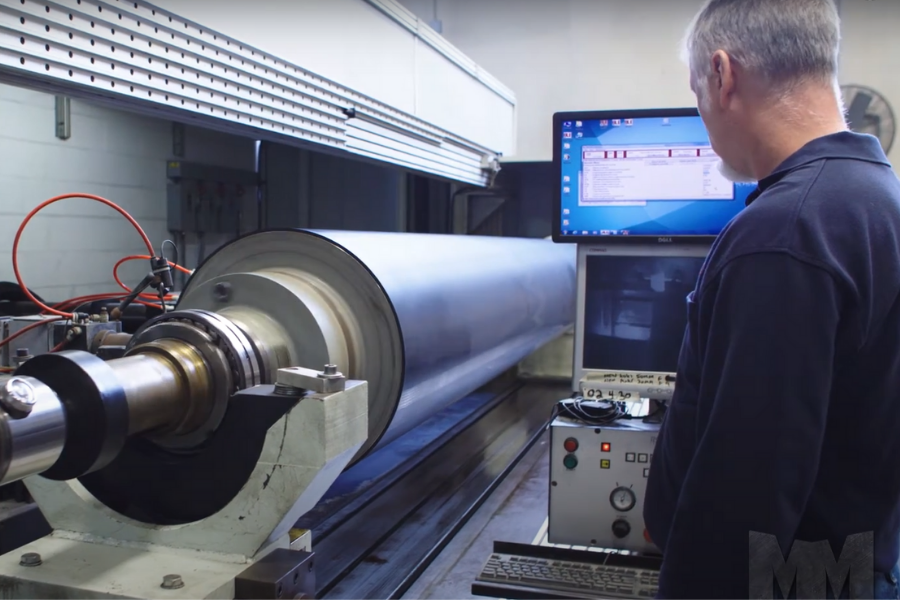
1. How has anilox roll technology evolved and improved over the years.
The evolution of anilox roll technology has been customer driven. Flexo printers are looking for improved quality to be able to continually keep up with demands of their customers. With the costs still associated higher on digital platforms, customers want the digital quality at the Flexo pricing. In order to do this, anilox engravers have pursued updated technology in the lasers as well as the software used to engrave.
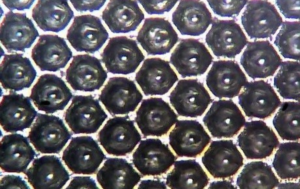
Fiber Laser Engraving
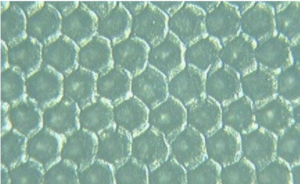
CO2 Engraving
Laser Improvements: The CO2 lasers of the past used a lot of power and hit the ceramic hard. This would give you a deep cell that did not have a strong geometric shape. Modern fiber laser engraving systems use less power and have multiple hits. This allows the shape of the cell to stay much more geometric. You can say that the CO2 lasers are like a plow and the fiber lasers are more like a scalpel.
The CO2 lasers also would engrave in the shape of a funnel or tornado. The deeper the cell went, the narrower the bottoms would get. This created a deep non-efficient cell. With the new fiber laser you can maintain a more open cell with a nice flat bottom. This helps with efficiency and cleaning of the cells.
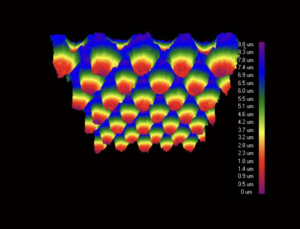
New Style Engraving
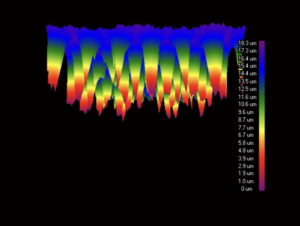
Funnel/Tornado Type Cell
Software updates: The software for the lasers plays a significant role on how the laser performs.
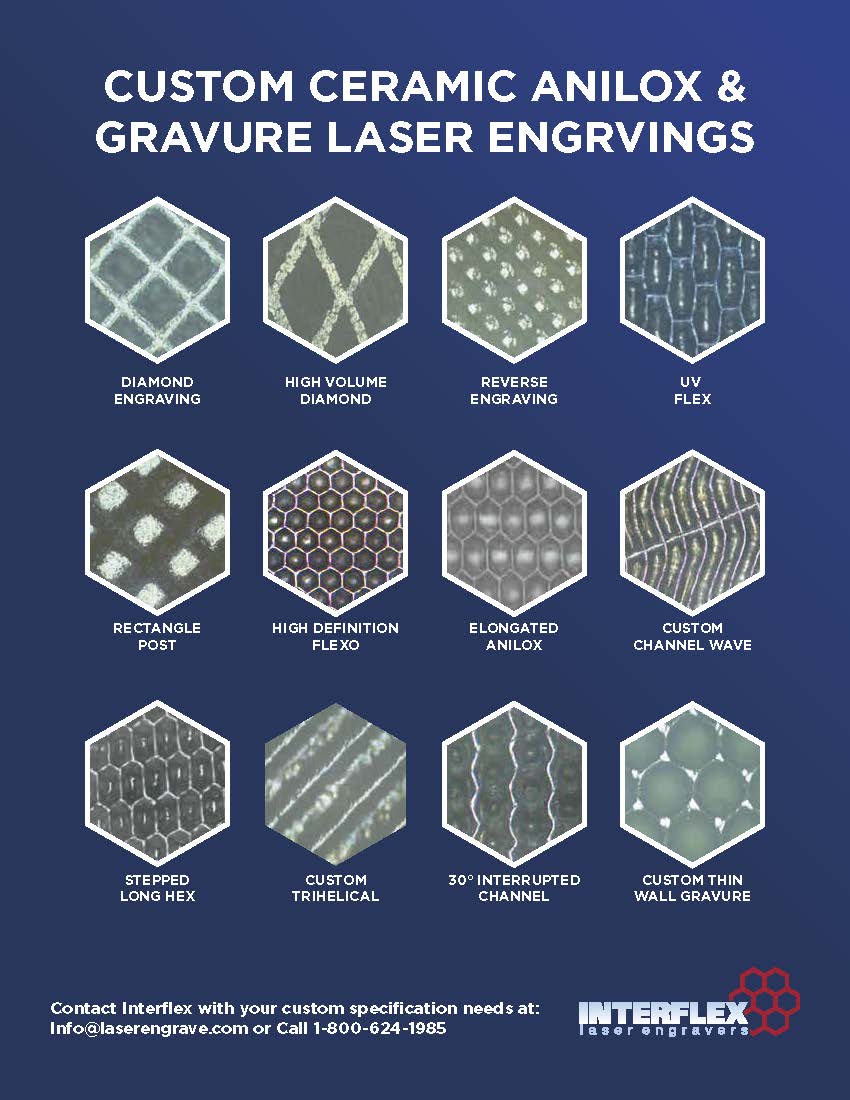
With the evolution of the software, engravers have been able to increase the speeds in which an engraving can be completed. The software also allows talented engravers to be able to develop different cell formations. These cell formations are used to keep up with the demands needed by our customers.
Here are a few of our custom cell formations Interflex Laser Engravers offer:
2. Why are the anilox rolls called the heart of the flexo printing process?
 If you look at the printing process, at the basic level you have four main parts that work together in order to print properly. You have ink, anilox engraving, doctor blades, and printing plate. The ink would be considered the “blood” of the press. The “blood” cannot do its job unless it is moved correctly. The anilox would be considered the “heart” as it needs to deliver the “blood” to the printing plate. Also, just like the heart, it has to deliver the exact amount of liquid needed at the right time. The doctor blades would be considered the valve, it makes sure that the ink is metered. The plate would be the body. The body needs the correct amount of ink to make the process work.
3. Are there any trends within the narrow web industry effecting anilox roll development?
The narrow web label printing industry continues to push anilox roll development. They are always pushing the envelope on quality. They are using an array of different inks, coating, and substrates to catch the eye of the consumers. Most of the larger narrow web printers have introduced some type of digital process to their plants. All of this plays a part on how we continually improve our anilox processing.
4. What are the results of using inferior anilox technology?
Just as described above, there are four parts of the printing press that have to work together to even start the printing process. The anilox, being the heart of this process, has to work properly. If you have ever had a “heart” issue you understand how this affects everything. Using inferior products will reduce quality, increase downtime, reduce press run time, and adversely affect your bottom line. It is also important to know that using quality parts incorrectly can hinder your ability to create quality. Make sure that you know how to handle and take care of your anilox engravings as well as the other parts. Talk with your suppliers and see what training they offer to ensure that the work force understands how to use each part correctly. Interflex Laser Engravers offer Anilox 101 training. This training can be done virtually if needed.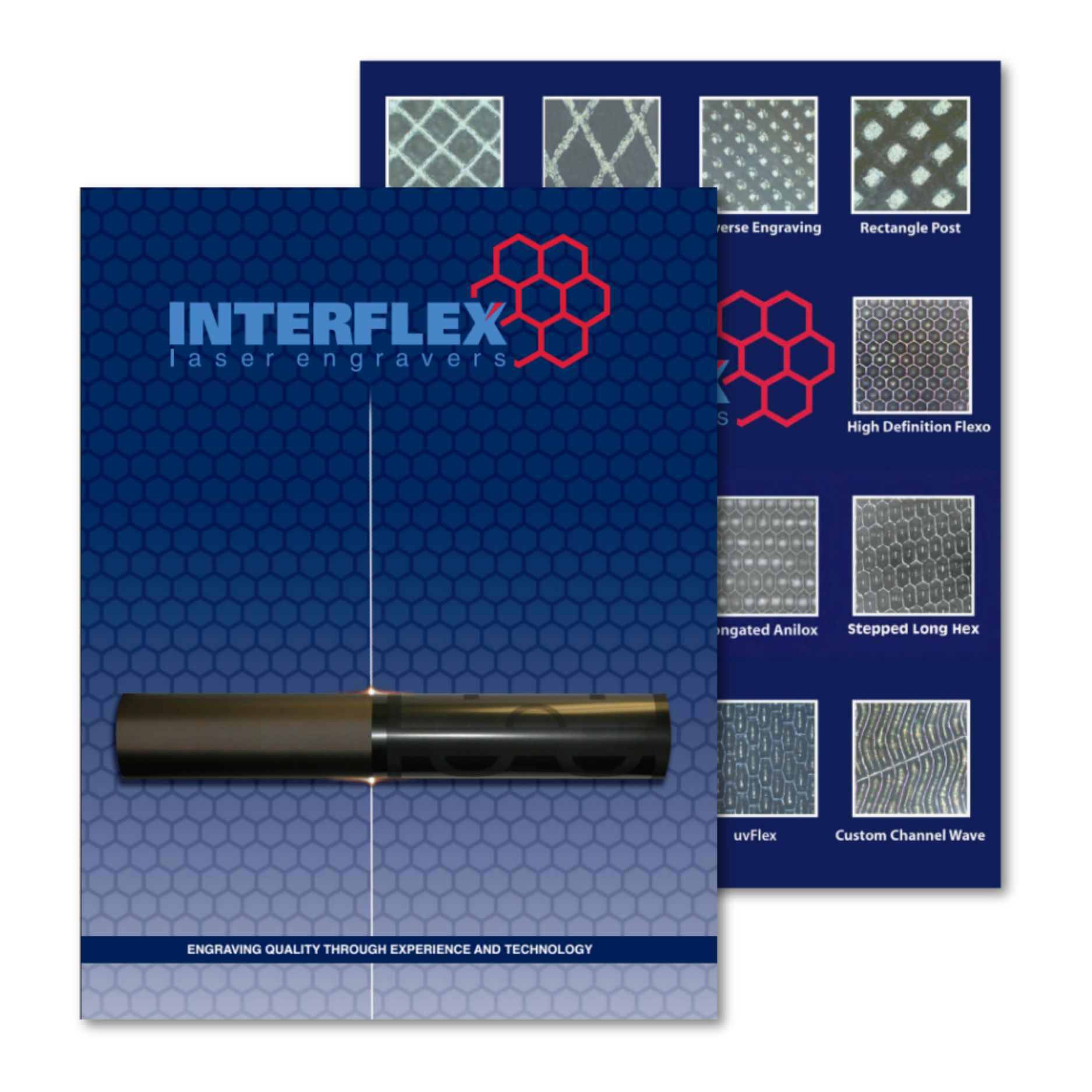
5. Please describe in detail the anilox products your company offers? Advantages to label converters?
Interflex Laser Engravers’ focus is on engravings and servicing our customers. This is what we do best.
- We don’t make new bases or sleeves, but we will quote and keep inventory on our shelves for active customers.
- We don’t sell protective covers, but we will be more than glad to install or purchase and sell back to our customers.
- We don’t sell or make cleaners, but we will send you information on cleaners we have tested.
- We are able to do this because of the close relationship we maintain with our group of quality suppliers.
Download Interflex Laser Engravers’ Brochures.
6. How are they made?
Interflex Laser Engravers prides ourselves on holding some of the tightest tolerances in the industry. We can hold T.I.R. to .0002”. We hold our taper to .0005”.

AUTHOR: Mickey Bower, Interflex Southeast Technical Sales Rep
- Our ceramics are tested monthly by an independent third-party lab. The tests provide us with hardness and porosity numbers that we continually monitor so that we can continue to provide the best materials available.
- Our spray systems are calibrated by a third-party on an annual basis.
- We have an ALE technician locally that repairs and maintains our lasers.
- We offer three different and widely used volume testing processes. (ARMI, 3DQC, and Anicam)
6. What sets Interflex Laser Engravers apart from out competition?
We have made a concerted effort to focus on servicing our customers the best possible way. Interflex Laser Engravers offers them a quality engraving, on a timely basis, that we will stand behind. There are many anilox providers that have divided their focus on selling a variety of products. At Interflex, we put all of our efforts and pride in what we engrave.
Steve Jobs said it best: “Do not try and do everything. Do one thing well.”