

AUTHOR: Mickey Bower, Interflex Southeast Technical Sales Rep
My career in the printing industry started in 1987 at Southern Gravure in Louisville, Kentucky. I was raised in a Southern Indiana dairy farm area and had worked there since I could walk. From throwing hay bales (weighing around 50 pounds) and cleaning out stalls, I had done jobs that would make Mike Rowe cringe. When I was given the opportunity to start a career, I jumped at the chance. I started out at Southern Gravure on third shift at what they called the “worst job” they had. Of course, they didn’t realize their “worst job” was nothing compared to the jobs I had been doing. On top of that, they were paying 3-4 times the hourly rate I was getting on the farm. I spent the first part of my career scared that I was not doing enough to get that kind of compensation. I still remember the day they asked me to come in on day shift for a meeting with the boss. I thought they had finally realized their error and were going to let me go. Instead, they offered me an apprenticeship. I was stunned! Only after asking them to repeat what they had just said (twice) did I accept. I started my apprenticeship on a manual lathe. This is where I first heard of the term TIR. Fast forward 34 years to today, this former Southern Indiana farm boy has been asked to explain how TIR affects anilox roll performance.
What is T.I.R.?
Let’s start out and define what TIR means. TIR is an acronym for “Total Indicator Reading” or “Total Indicator Runout”. FIM or “Full Indicator Movement” has also been brought into the common nomenclature and has the same meaning as Total Indicator Reading. These two terms take into consideration flat pieces as well as round and tapered parts. They measure the surface finish and contour of the part as well as concentricity. We will reference these terms later in the article.
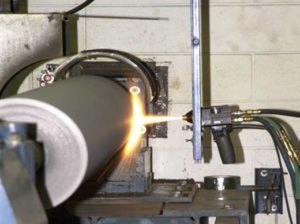 Total Indicator Runout, on the other hand, is traditionally used for cylindrical parts only. With Total Indicator Runout, a dial indicator is used to measure the amount of movement on a rotating part based on its referenced axis points. In layman’s terms, it wobbles when it spins on its axis. This wobble is called “run-out”. This is the translation of TIR that I will be using to discuss the first part of this article.
What is a good T.I.R. tolerance?
When processing and measuring anilox rolls it is important to follow the tolerances listed on the specific press manufacturer’s prints. This is normally between .001” to .0005”. The internal tolerance we achieve at Interflex Laser Engravers is .0002’’. Here is an example of how tight of a tolerance that is; A piece of printer paper has a thickness of about .001’’. If you could take that thickness and divide it into 10 pieces of identically thick parts, and then get rid of 8 of them, that is the amount of movement we would allow on a rotating anilox.
How does one determine which axis point to use for the T.I.R. measurement on shafted anilox rolls? Some anilox manufacturers will process and measure based on the center of the roll, but when we have asked our customers how many presses run off the centers, the answer is none. Understanding this, we measure all of our TIR readings from the bearing surface instead, as that is the way you are running in your presses.
If the face of the roll and all of its shafts are running true to the bearing surface, you will not have issues with run-out.
Sleeves and non-shafted tube type cylinders are a little different as they don’t have an axis point to reference (no shaft). Their concentricity is based on their outer and inner surfaces running together. The true test of run-out is when the sleeve is pressed onto your press mandrel. It is here that you can properly measure the amount of run-out that you have. To help reduce the chance of issues occurring when you check the sleeve on your press mandrel, Interflex Laser Engravers place each sleeve on a mandrel similar to what you have in the press and process it based on the bearing surfaces. We invest in these mandrels to ensure we create the same environment that you encounter in your process. This greatly enhances the success of your sleeve performing as it was designed.
What effect does run-out have on the performance of an anilox?
1. In the Press.
The flexographic printing press is made up of many parts and pieces that all have to work together to get a finished product out. All of the parts and pieces have specific jobs and tolerances. If one of those parts is out of tolerance then the press will not perform properly. The anilox is a very important part of the press. If you have run-out over the manufactures tolerance it can lead to the following issues:
- Excessive stress on the base or sleeve.
- If the part is not running properly, it can create stress and generate heat. In extreme cases it can break off shafts, damage sleeves internally, and damage other moving parts.
- Excessive stress on the doctor blades and chambers.
- The anilox run-out can affect the ability of the doctor blades to meter correctly. In some cases, the chamber pressure will have to be increased to prevent leaking which can wear doctor blades and seals quicker and damage the anilox.
- Damage to the plates or transfer roll.
-
- To compensate for run-out you would have to over-impress. This could cause the plate or transfer roll to be damaged along with print issues. This also could generate heat and stress that could damage the plate mandrel or transfer roll.
- Reduced printing speed in order to prevent bouncing, reduce heat generation, and printing issues.
Browse Interflex technical resources for tips and troubleshooting.
2. Laser Engraving
TIR also plays an important role in laser engraving. If the part being engraved has TIR issues it will show up dramatically in the quality of the anilox engraving.
- To understand this, you will need first to understand how a roll or sleeve is engraved. The laser setup at Interflex Laser Engravers consists of 2 adjustable chucks and an engraving head that traverses across the roll surface as the roll rotates. Once the engraving head is set at a certain distance from the anilox, it is locked into that location or focus point. If the anilox roll has excessive runout or taper (TIR) the focal point will change as it traverses. This could give you shallower or deeper cells around the diameter (runout) and across the horizontal roll face if the taper is not controlled.
- In the example of a 1200 LPI 2.0 BCM engraving, the depth is less than .001”. If your runout is .001” then the distance from the engraving head to the surface will change as it rotates. This can give you areas of engraved cells that are deeper and/or shallower around the engraving. If you taper or profile is over .001” you will have the same issue across the engraving horizontally. All of these issues lead to downtime and frustrations.
Total Indicator Reading
In the topics above we have been discussing “run-out”. The other part of TIR is what we would call taper or profile. That would be the difference that you could measure with a dial indicator going horizontally across the anilox face. This is an important measurement to help prevent issues. Keep in mind that this test should only be performed prior to engraving. Testing after the anilox has been engraved can cause damage to the engraved surface. At Interflex we have an internal tolerance of .0005”. Imagine that piece of paper again but this time you are getting rid of 5 of the pieces. That would be half the thickness of the paper. This is important for doctor blade wear, doctor blade metering, laser engraving (as described above), and consistent release of inks and coatings.
How to prevent these issues with run-out
- Check with your anilox provider on the tolerance they use for each part they send you.
- Make sure that they are referencing the bearing surface and not the centers of the anilox when recording TIR.
- On shafted rolls make sure that you have good bearings on the roll before you install it in the press. Even if the engraved and bearing surfaces are concentric, a bad bearing will cause issue.
- Protect the shafts on roll aniloxes so that they don’t get damaged or bent.
- On sleeve aniloxes make sure and keep the inside of the sleeve and the outside of your press mandrel clean. If you get contamination, such as ink, damage, or even heavy dust, on the mandrel or the inside of the sleeve it can cause that area to run-out.
- Protect sleeve aniloxes. These are prone to damage and if they get hit or bumped, they can become out of round. Once this happens, they will not run concentric in the press.
In Conclusion
TIR was one of the first things that I learned in my 30 years + of working in this industry. It is truly one of the foundational elements needed in manufacturing and engraving any type of roll or sleeve used in our industry. If the TIR is not good at the fabrication or start of the anilox process, then the anilox will not perform properly. When I was back on the farm, we had a saying. “You can’t make chicken salad out of chicken crap.”